


I can’t remember how old I was when I first heard about “the cloud”. It’s somehow always been there, omnipresent in daily life, but very much in the background, like TV and taxes.
The name – “the cloud” – has a weightless quality. It’s far removed from the giant datacentres and racks of servers that service it. We store photos and files on it and stream the next World Cup fixture using it. It’s easy to forget about the power and space needed to enable it when it’s offset to a location that you’ll likely never know about or see with your own eyes.
Yet, it’s not weightless at all. Far from it.
Hannah Ritchie, Deputy Editor and Science Outreach Lead at Our World In Data and Senior Researcher at the University of Oxford wrote about the electricity consumption of AI and the cloud last month on her Substack. She reported that 1.5% of the world’s electricity was used to power datacentres in 2025, with around 0.5% used by AI alone.
It doesn’t sound like much, until you see that the share of electricity used by AI is set to triple by 2030.
The cloud also has an insatiable thirst. A report from the Government Digital Sustainability Alliance predicts that AI will increase water consumption from 1.1bn to 6.6bn cubic metres by 2027 – about half of the UK’s total water usage. Datacentres use that water in three main ways: to cool servers, to generate the electricity that powers them, and to manufacture the chips they run on.
Global averages are neat and tidy to look at, making the demand look manageable. That’s until you understand how localised it is. Datacentres have a postcode, a grid connection, and sit on a water table. It’s quite a challenge to get them situated, powered and cooled without impacting a community or the natural environment.
The answer to this isn’t to use less intelligence, but to make it work harder for every watt and litre. That means more efficient compute, better infrastructure, smarter cooling, grid-aware datacentres, smaller and more targeted models, and new ways to move and process information.
Some of that work is already visible across our portfolio, not as one silver bullet, but as different ways of taking weight out of the system.
iPronics is using software-defined photonics to move data through AI datacentres with lower latency and lower power. Secondmind’s optimisation work points to the kind of intelligence grids will need as demand, renewables, storage, and electric vehicles become harder to balance. XMOS pushes more processing to the edge of the network, so devices can make decisions locally rather than sending every task back to the cloud. Paragraf is showing how graphene-based semiconductor devices can offer a more energy-efficient route beyond silicon alone. Collectively, creating a cloud that carries its load more intelligently.
For years, the cloud has sat in the background of daily life, as familiar and forgettable as TV and taxes. AI is making it more visible. If the next generation of systems is going to scale, the cloud must become lighter in practice, not just in name.
Read on for more news from our portfolio and partners across Intelligence, Human, and Planet this month.

Intelligence
Physical AI on the warehouse floor. Slamcore secured $14m to scale visual AI across intralogistics, tracking vehicles with stereo cameras rather than GPS, beacons, floor markers or costly facility changes. Its Aware and Alert products are already deployed across more than 30 facilities, turning warehouse movement into a usable data layer for safety and efficiency.
Recognition for trustworthy AI. UnlikelyAI founder and CEO William Tunstall-Pedoe has been named Alan Turing Innovator of the Year at The National AI Awards 2026, recognising a career that spans the foundation of Alexa to the future of trustworthy AI.
Quantum networking gets practical. Nu Quantum published research showing distributed quantum systems can tolerate the failure of individual quantum processing units, then announced a collaboration with Atom Computing to build the photonic networking hardware needed for neutral-atom systems to scale.
Guardrails for enterprise agents. PolyAI’s June Agent Studio release adds platform guardrails, A/B testing, simulation tests, and chat-agent building alongside voice. The direction is clear: agent deployment is moving from “can it work?” to “can we control, test and improve it?”
Engineering AI reaches Japan’s OEMs. Secondmind signed a strategic reseller agreement with SC Automotive Engineering to bring its model-based engineering AI to Japanese automotive OEMs and Tier 1s. The aim is to cut development friction as vehicle programmes become more complex.
Sitehop joins the WEF Technology Pioneers. The World Economic Forum selected Sitehop for its 2026 Technology Pioneers cohort, recognising its post-quantum-ready encryption for critical networks. Coverage notes the company’s hardware is already deployed by a Tier-1 global telco across seven countries.
Refute in The Times. Katie Prescott’s feature on corporate disinformation highlights Refute’s work helping organisations detect and respond to manipulation before false narratives harden into real damage.
Human
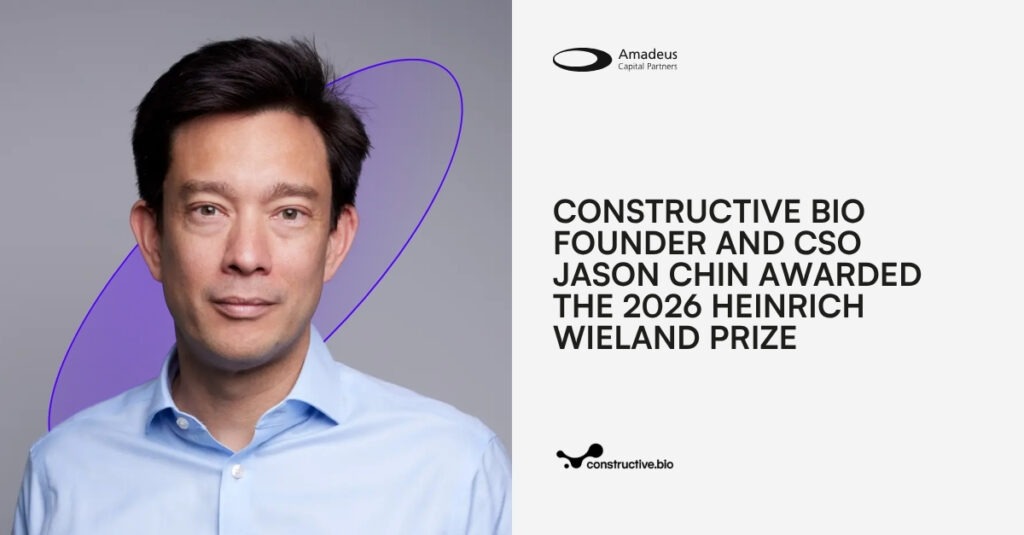
Prestigious recognition for genome writing. Constructive Bio founder and Chief Scientific Officer Professor Jason Chin has won the 2026 Heinrich Wieland Prize, recognising his pioneering work in synthetic biology and genetic code expansion — technology now being applied to next-generation therapeutics, including GLP-1s.
AI prostate analysis cleared in Canada. Quibim received a Health Canada licence for QP-Prostate v2.4, expanding access to its AI-powered prostate MRI analysis across Canada.
National tumour classification in Norway. Oxford Nanopore and MATRIX expanded their collaboration to implement rapid CNS tumour classification across Norway, moving from evaluation into structured deployment across the public healthcare system.
PhoreMost moves towards the clinic. PhoreMost announced PMC-001, its lead oncology programme for primary and secondary brain cancers, and appointed Dr Gabriel Fox as Chief Medical Officer to support clinical entry.
Doctify enters Saudi Arabia. Doctify launched in Saudi Arabia as the country’s Vision 2030 health transformation programme pushes patient choice and healthcare digitisation further into the mainstream.
Nuclera tackles the antibody bottleneck. Nuclera’s latest blog focuses on early hit triage for AI-generated antibodies, helping teams move from predicted candidates to useful experimental binding data faster.

Planet
Space manufacturing gets a return route. Elethron and ATMOS Space Cargo completed an engineering collaboration to integrate Elethron’s materials lab with ATMOS’ PHOENIX return vehicle. The work de-risks end-to-end microgravity R&D, from launch to processing to return.
Xampla moves from lab to market. Packaging Scotland covered Daniel Zeichner MP’s visit to Xampla, where he saw Morro materials scaling from Cambridge research into real-world packaging. The piece highlights Morro Coating’s use in food packaging and Xampla’s Just Eat Takeaway.com partnership across 10 European markets.
Graphene sensors at scale. Electronics For You covered Paragraf’s PMF2000 GFET, a graphene-based molecular sensor designed for healthcare, agritech, environmental testing, chemistry, and industrial monitoring. The device is the first from Paragraf’s large-wafer production facility in Huntingdon.
Epoch’s nylon recycling push gets fresh coverage. Recent industry coverage points to Epoch Biodesign’s planned London demonstration plant for nylon 6,6 biorecycling, built to show its enzyme-led process can handle difficult post-consumer materials at meaningful scale.
News from the team
Policy certainty for deep tech. Partner Amelia Armour contributed to Mike Butcher’s latest Pathfounders piece on what UK startups and investors want from the next Chancellor. Her point: the UK does not need another slogan — it needs long-term delivery across AI, quantum, compute, robotics, defence, and advanced engineering.
Space and defence on stage. Amelia Armour and James Baker joined panels at London VC Summit 2026 on two markets moving from specialist interest to strategic priority: spacetech, aerospace, dual use, and defence.
If you enjoyed reading this issue of Capitalise, why not subscribe below to receive it directly to your inbox.