

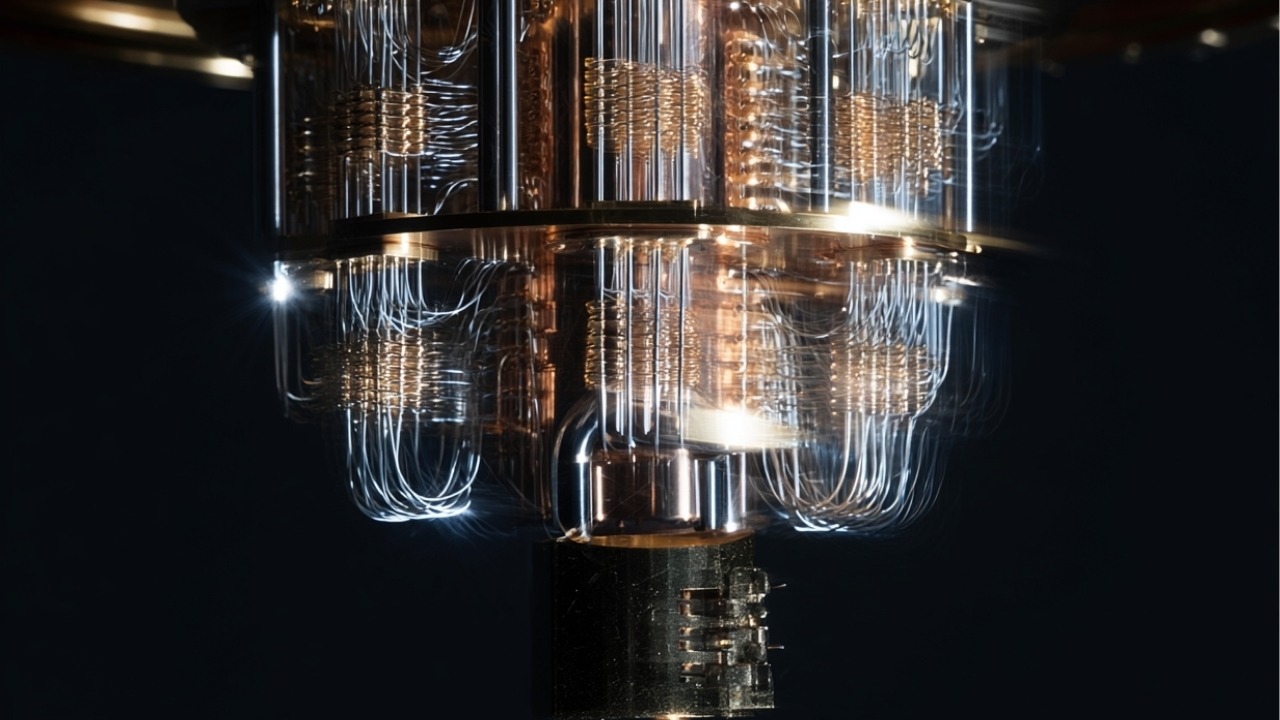
Sipping a coffee while idly browsing the internet is, for most of us, an unremarkable part of the day. We check our finances, scroll through social media, shop, and work. What we take for granted, is the security propping it up.
That assumption could begin to unravel when Q-Day arrives.
Q-Day, as it’s commonly known, is the point at which a sufficiently powerful and fault-tolerant quantum computer can break public-key cryptography. This is the mathematics that secures much of what we rely on day to day, from websites and bank transfers to private communications and software updates.
Today’s quantum computers haven’t reached this point yet, but each advance in hardware, error correction, and algorithm changes the estimate of what a machine capable of it would need. This speed of change has caught Hermann Hauser’s attention.
Few people have watched more technology waves pass than our co-founder and Venture Partner. Hermann has seen microprocessors, the internet, mobile computing, and AI move from research to daily life. Speaking at London Tech Week earlier this year, he said: “I’ve never seen a technology wave where key milestones came in from the future so fast.”
He was talking about quantum computing, and how quickly the assumptions behind Q-Day are changing.
That change is already shifting security plans. Earlier this year, Google set 2029 as its own deadline for migrating to post-quantum cryptography. This reflects the time it believes the transition could take and the risk of starting too late, not the day it believes Q-Day will arrive.
The National Institute of Standards and Technology (NIST) has already published the first post-quantum standards and advised organisations to start using them now. In the UK, the National Cyber Security Centre expects organisations to understand where vulnerable cryptography sits across their systems by 2028, protect their most important assets by 2031, and complete the transition by 2035.
Much of the urgency comes from encrypted data being intercepted today and stored until a sufficiently powerful quantum computer can crack it.
Attackers don’t need to understand a stolen file for it to be valuable. Medical records, trade secrets, government communications, and critical infrastructure data may need to remain private for years. They can be collected now and held until the technology arrives.
In that sense, Q-Day begins far before it’s arrived.
Fortunately, post-quantum cryptography runs on the conventional computers we use today, and the first standards are already available. The less convenient news is that cryptography is embedded in almost every layer of our increasingly digital world.
Replacing it would be like changing all the locks across London, without closing any of the buildings.
The technology isn’t being developed to break encryption, but it is a consequence of its power. The promise lies in solving problems that classical computers could take millions of years to process, with potential applications across medicine, materials, energy, and industry.
This creates work on both sides of the technology wave. Researchers and companies like Riverlane, Nu Quantum and Photonic are building the error correction, networking, and architectures needed to make quantum computers useful. At the same time, infrastructure must become capable of adopting new cryptographic standards without becoming slower, less reliable, or prohibitively expensive.
Sitehop is working on that practical layer, using reprogrammable hardware to secure data moving across networks while allowing cryptography to be updated as standards and threats evolve.
The transition won’t happen through one universal software update. Banks, governments, hospitals, telecoms networks, technology providers, and their suppliers will have to find where vulnerable cryptography sits, replace it without disrupting the services around it, and keep old and new systems working together along the way. It will take years, which is why the deadlines are arriving before the technology.
It’s a mammoth task, but success will look like nothing happened at all. We’ll sip our coffee and life will go on.
Read on for more news from our portfolio and partners across Intelligence, Human, and Planet this month.

Intelligence
Recurvia awarded €2.44M by the EIC. Recurvia (formerly Inephany) announced that it was awarded a non-dilutive grant by the European Innovation Council (EIC) to fund the development of Paramorph, its foundation model for neural network optimisation.
The Great (AI) Escape. Secure Agentics CEO, Max Corbridge, spoke on the BBC News at Ten to share his views on AI escaping test environments and hacking companies – “What we’ve seen so far was not representative of the real world.”
V7 connects with Pitchbook. V7 announced a PitchBook integration for V7 Go agents, allowing investment teams to pull private-market data directly into workflows.
Speed is only part of the equation in AI. PolyAI CTO Shawn Wen published a technical blog about how speed is only part of the architecture in voice AI for nuanced human conversations.
Tenzo launches an AI Connector for hospitality. Tenzo launched an AI Connector that links live sales, labour, inventory, and operational data with LLMs so teams can ask questions in plain English.

Human
Parkinson’s UK tests Charco CUE1+. Charco Neurotech welcomed publication of an independently conducted, randomised, double-blind trial of its CUE1+ device as a feasible intervention for people with Parkinson’s, shared by Parkinson’s UK.
Oxford Nanopore strengthens its leadership. Oxford Nanopore announced David Miller as Chief Development and Product Officer and Conor McKechnie as Chief Marketing and Communications Officer, strengthening product development, market positioning, and commercial execution.
Planet
Graphene sensing portfolio expands. Paragraf launched the PMF2002 GFET Platform and Enterprise Reader, expanding its graphene sensing portfolio with a 12-channel multiplexing platform and direct electronic readouts for faster assay development.
Recycled nylon hits industrial scale. Epoch Biodesign acquires a nylon 6,6 production facility in Blanes, Spain, to bring recycled material to the apparel, automotive and industrial markets.
Xampla features on BBC’s The One Show. Xampla featured on the BBC’s The One Show as part of the programme’s 20th anniversary celebrations – showcasing its natural polymer technology is a direct replacement for single use plastic.
News from the team
James on AI safety for Sifted. Our Principal, James Baker, features in Sifted’s latest article on the 12 AI safety startups to watch, according to VCs.
Hermann on CNBC. Our co-founder and Venture Partner, Hermann Hauser, joined CNBC’s The Tech Download to discuss why Europe still finds it harder than the US to build and keep global technology companies.
If you enjoyed reading this issue of Capitalise, why not subscribe below to receive it directly to your inbox.